

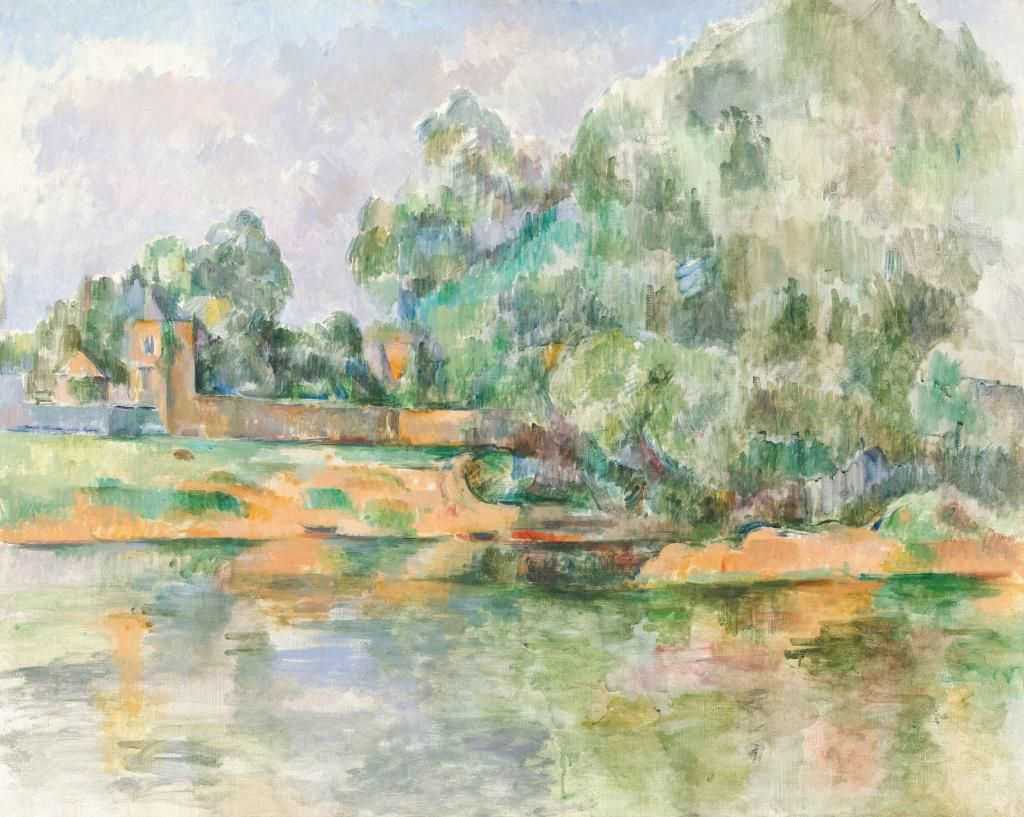
Cézanne through the eyes of those who followed him
Until 17 January 2027, the Grand Palais is dedicating an exhibition to Paul Cézanne that breaks with the usual format. There is no chronological biography here: Cézanne and us looks at what artists went on to do with his work. Around 180 pieces are brought together, including about 70 canvases by Cézanne himself, shown alongside works by Gauguin, Matisse, Picasso, Mondrian, Joan Mitchell, Bridget Riley and Peter Doig.
A journey built as a dialogue
Where so many retrospectives follow the career of a single painter, this one tells a dual story. On one side, Cézanne's hold over the generations of the 20th century; on the other, the ways in which those artists took him up: celebrating him, challenging him, sometimes rejecting him. Acknowledged legacies, borrowings, aesthetic disagreements: nothing of these tensions is smoothed over.
From Père Tanguy's shop window to 1907
The story begins in the late 1880s. Cézanne had stopped exhibiting, but young painters and a handful of collectors came to see his canvases at Père Tanguy's, the colour merchant's shop. There they discovered a boldness of form that answered their search for a stripped-back art, already close to abstraction.
His recognition came in three stages:
- the solo exhibitions orchestrated by the dealer Ambroise Vollard;
- major museum presentations, first in France and then abroad;
- posthumous retrospectives, including the 1907 Salon d'Automne.
The hang plays on two registers: reconstructions of historic exhibitions and face-to-face pairings of works, bolder in their choices.
From Matisse to Peter Doig: an influence that spans the century
For the avant-gardes, Cézanne became a point of reference. His idea of art as "a harmony parallel to nature" gave them a way of thinking about the link between painting and reality. The exhibition follows this thread from lyrical abstraction to geometric abstraction, and on to "hard edge" painting. Whether they wanted to build on his lessons or break free of them, every one of these artists had to position themselves in relation to him.
With postmodernism, even his title of "father of modern art" has been called into question. The exhibition does not take sides: it invites visitors to look at Cézanne through the eyes of those who looked at him before us, and then with our own.
Practical information
- Until 17 January 2027
- Where: Grand Palais, avenue du Général Eisenhower, Paris 8th (galleries 3 and 4)
- When: every day from 10am to 7.30pm, except Mondays; late opening until 10pm on Fridays
Why go?
Because it is rare to see so clearly how a body of work keeps shaping artists long after it was created. Whether you are a painting enthusiast or simply curious, it is a chance to reread a classic through those who carried it forward. It is one of the great cultural events of this Parisian autumn.
After your visit, come and tell us what you thought: the team at Hôtel Moderniste is on hand to advise you throughout your stay in Paris.
Photo ©National Gallery Of Art - Unsplash